
Starting a small business in Ontario is exciting, but it can feel like a lot to figure out at once.
The short answer to “How do I register my business in Ontario?” is this: choose your business structure, pick a business name, complete the registration or incorporation, pay the required fees, and receive your official registration documents.
Registering your business in Ontario may involve different steps depending on whether you operate as a sole proprietorship or corporation.
In the sections that follow, we will walk through each step of the process so you know what to do, what it may cost, and what to expect at each stage.
Key takeaways
- Registering a business in Ontario starts with choosing a business structure, selecting a name, and completing the required filings through the Ontario Business Registry.
- Sole proprietorships are the most affordable and straightforward options, while incorporation provides added legal protection and potential tax benefits, but requires more documentation.
- Knowing the required documents, fees, and compliance steps early on helps you register smoothly and operate legally from day one.
How to register a sole proprietorship or partnership in Ontario
Registering a sole proprietorship and a partnership have many things is common. The difference is that you are the only owner in a sole proprietorship. The sole proprietorship business registration process is the simplest and least expensive way to register a business in Ontario. It does, however, offer the least amount of legal protection.
Registering a partnership is nearly as simple as a sole proprietorship, and the costs are also comparable. You will have to make a choice to either register as a general or a limited partnership. The difference? A general partnership usually involves a fair split between all partners.
A limited partnership acknowledges that some partners are not equally as involved and therefore don’t get compensated in the same way.
Note: Ownr currently supports online registration for sole proprietorships. Partnerships, including limited partnerships, must be registered directly through the Ontario Business Registry.
There are several similar steps to registering both a sole proprietorship and a partnership. Most of those steps involve registering a name for your business under the Ontario Business Names Act (BNA). You don’t have any legal obligation past registering your business name when forming a partnership or sole proprietorship.
However, it’s important to note that in a partnership or sole proprietorship, there is no distinction between you and your business in terms of legal and financial liabilities.
For example, you (and your partners) may be personally responsible for your business debt. This is not the case when you are incorporated.
Here are 3 steps you need to register a sole proprietorship or partnership in Ontario:
1. Name your business
Unless you’re using your own legal name, you have to choose a distinct business name (since two businesses cannot operate using the same name under the same jurisdiction). Even if your name is Kim Jones and you want to call your business “Kim Jones Flowers”, your business still needs to be registered.
Your business name also cannot be misleading. For example, you can’t call yourself “Kim Jones Inc.” because you’re not a corporation. Your business name will stay registered for five years, at which point you’ll need to renew your registration. You have 60 days from the time your name expires to complete the renewal.
- Why should you do a business name search: A unique name can offer many brand recognition advantages. It’s the first thing customers identify your business with. Having a name similar to another business makes it harder for yours to stand out. Or if that other company is incorporated, they have the right to take you to court.
That’s why it’s important to perform a name search in the government’s database to make sure your preferred name isn’t already taken or too similar to existing businesses.
- How to do a business name search: There are different ways to go about searching for your business name. You can start with a casual internet search. This will eliminate the obvious businesses that are already operating.
Once you’ve done an online search, move to official name search tools that check your names against the government data. You can pay for each search via the government site directly, or use Ownr’s platform, which lets you search up to 30 names for free before registering your business. You’ll know in real time whether or not the name you’ve proposed is available.
2. Register your business
Now that you’re happy with a unique name for your business, it’s time to officially register your sole proprietorship or partnership through ServiceOntario or explore Ownr’s new business setup options to complete the process online.
Here’s what you’ll need to prepare in advance:
- Your name and business mailing or office address — Legal documents will be mailed to you. There must be a name and a valid physical address to which these documents can be sent.
- A valid email address — If you provide an email address, you’ll receive the Business Name Registration for a Sole Proprietorship within two business days after registering. This is your proof of business registration in Ontario under the Business Name Act.
- A description of what your business will be doing — You need to summarize the function of your business. You don’t have to go into great detail. Just a one-line, general description. So if your business is a bakery, something simple like “selling baked goods” works well.
- Names of partners — If you have partners, you must list all of their names.
- Partnership agreement — This is not required to register your partnership, but it is strongly recommended. Even though you and your business partners surely have good intentions when starting out, but things happen.
Circumstances occur, and partners may choose to go in a different direction. A partnership agreement is a legal document drawn up by a lawyer that outlines how decisions are made, the duties of each partner, how profits will be split, and other aspects of how your business will function.
Once your business is registered, you’ll receive a nine-digit BIN number (Business Identification Number). This number is what identifies it as registered in Ontario. With your BIN number, you can now open a business account, access wholesale pricing from suppliers, advertise your business and operate in Ontario for five years or until you decide not to renew your registration.
What the BIN doesn’t do is protect you as an individual from liability. For instance, if you take out a business loan under your business name but can’t pay back that loan, you will personally be liable. A BIN also doesn’t give you any corporate tax benefits or protect your name from being used by other businesses. These are all benefits of fully incorporating your business.
3. Register additional licenses and certificates
You’ll have to operate your business in accordance with provincial regulations. That may require you to collect HST for your business, in which case you’ll need to create a GST/HST account.
You may also need to register for Workers’ Compensation Insurance. Even though you’re only operating as a sole proprietor, it’s still important that you take this step of identifying any licenses or certificates you need in order to operate legally.
Do this research even if you’re operating under your own name and haven’t registered a unique business name.
Necessary filing requirements for a business registration in Ontario
Ontario requires specific information and documents before your business can be registered and legally operate. The details change slightly depending on whether you are a sole proprietor, partner, or corporation, but some core information is always required.
Core information for all business types
- Business name: If you use a name other than your exact legal name, you must register that name so it appears on public records and can be used on contracts, invoices, and marketing materials.
- Business address: You need the address of your principal place of business, along with a mailing address if it differs. This is where government notices and official correspondence are sent.
- Owner or director details: You must provide the legal names and contact information of the business owner, partners, or corporate directors so the government can identify the responsible parties.
- Business activity description: A short description of what your business does (often using a NAICS code) helps the government classify your business and may affect licensing or reporting requirements.
- Contact email and phone number: A valid email and phone number are needed for confirmations, updates, and follow-up about your registration.
- Payment of registration fees: All registrations require payment of a government fee at the time of filing. The amount depends on your business structure and the type of filing you complete.
In addition to the core details above, corporations have a few additional filing requirements:
- Registered office in Ontario: A corporation must list a registered office address in Ontario where legal documents can be delivered. A post office box alone is not acceptable.
- Articles of Incorporation: You must file Articles of Incorporation that set out your corporation’s name, share structure, and key rules about how it is organized.
- Corporate name and, if needed, a NUANS report: If you choose a word name instead of a numbered name, you may need a NUANS name search report to confirm that your proposed name is available.
Before filing, make sure all names, addresses, and contact details are accurate to avoid delays or issues when updating your records. Use a business address where you can reliably receive mail, and keep copies of your documents and receipts in one place for easy access when renewing or making changes.
Benefits of registering a business in Ontario
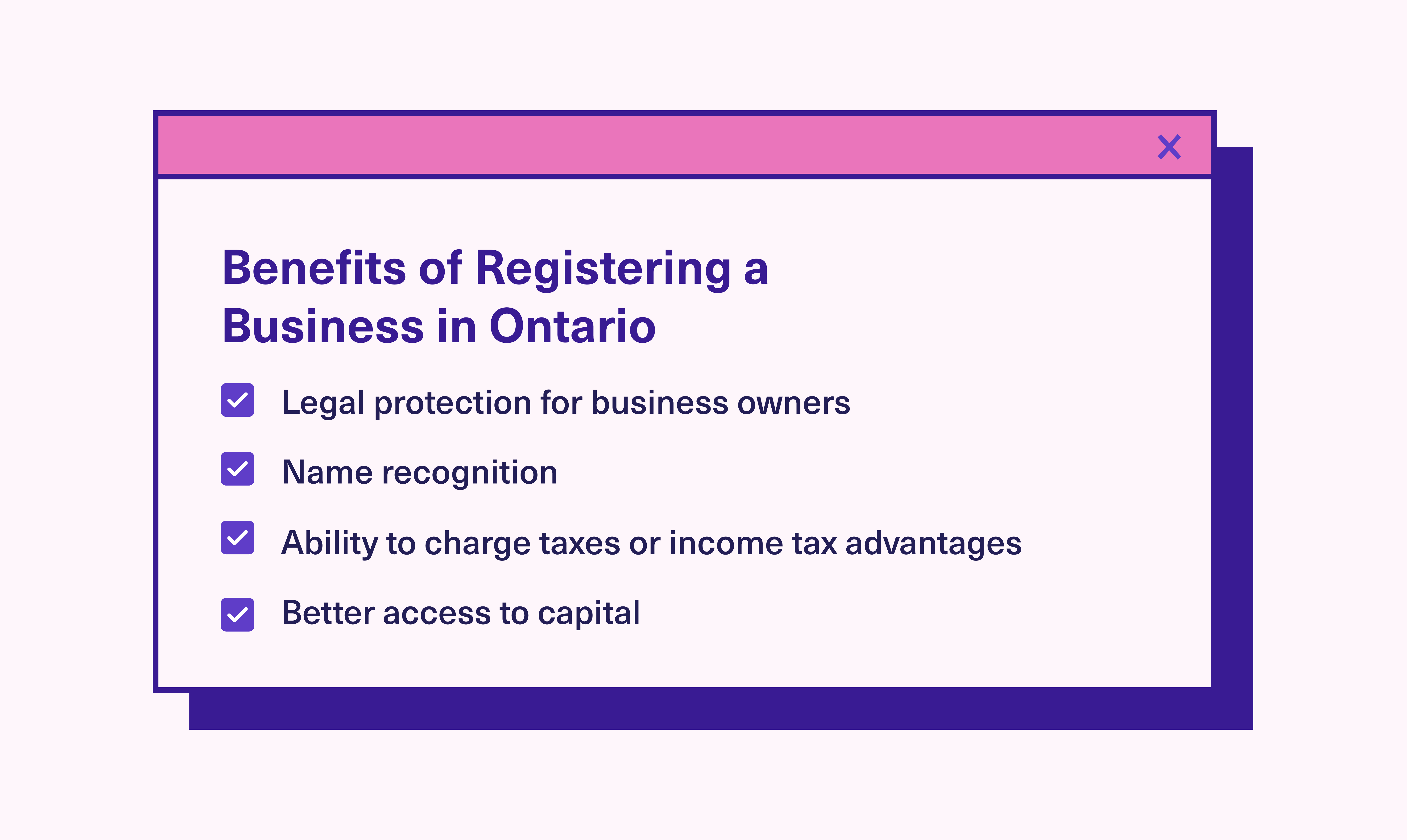
Beyond allowing the provincial government to keep track of all those doing business dealings within Ontario, there are reasons why you as a business owner will want to formally register your business. Some of these include:
- Legal protection for business owners
- Name recognition
- Ability to charge taxes or income tax advantages
- Better access to capital
This is just a sampling of the advantages to entrepreneurs. Read Ownr’s article on the benefits of registering a business, the advantages of partnership business structures or why you should register your Ontario business as a sole proprietorship for more details.
Do you have to register your business in Ontario?
In most cases, you will need to register your business in Ontario with the Ontario Business Registry. One exception is if you are operating your business as a sole proprietorship under your exact legal name. You will need to register your business if it is:
- A sole proprietorship operating under a business number or unique business name
- A limited or general partnership
- A corporation
- A Limited Liability Partnership (LLP)
For a broader overview of what it takes to launch a business before registering, read Ownr’s guide on how to start a business in Ontario.
Types of business registrations in Ontario
There are a number of business structures for registering your business in Ontario. These include sole proprietorships, partnerships, corporations, or Limited Liability Partnerships (though you must be a lawyer, accountant, or another regulated professional to form an LLP). For a more comprehensive understanding of all business types, read our article on how to choose a business structure. With this said, the majority of the businesses fall into either sole proprietorship, partnership, or corporation, so we’ll focus on these three types.
Note: We strongly encourage you to seek independent legal advice before proceeding with your business structure rather than solely relying on online resources like this article.
How much does it cost to register a sole proprietorship or partnership in Ontario?
If you choose to register or renew your partnership or sole proprietorship application directly with the government, there are costs for several items. To register or renew your business name, it costs $60 online, by mail or email for a sole proprietorship or a general partnership; and it costs $210 for a limited partnership. There are additional costs for the name search report (typically around $25 for a NUANS name report).
If you use Ownr to register for sole proprietorship online, it costs $49.00 plus HST. The fee includes registration and up to 30 name searches. Read more about registering a sole proprietorship in Ontario and everything you need to know about business licenses in Canada.

How to incorporate a business in Ontario
Incorporating your business means you’re essentially creating another legal entity. Your business will have the rights and liability protection that is similar to a person’s. What’s important to remember is that these rights are only extended provincially. You’ll have to incorporate federally for those benefits to be recognized across the country. Read Ownr’s guide on whether incorporation or a sole proprietorship is right for you.
For the above reasons, the registration requirements for incorporating your business in Ontario are more detailed and expensive than incorporating as a sole proprietorship or partnership: you’ll have the option to register either a business name or a business number, and a set of documents called Articles of Incorporation, which is essentially a summary that outlines the purpose of your business. There are a lot of steps to incorporate, so take your time to make sure nothing is missed if filing yourself.
1. Search for possible business names
If you decide to incorporate using a unique business name (opting over a business number), similar to a partnership or sole proprietorship, it’s a good idea to start with a basic name search. Once you’ve determined that you can proceed with your name, it’s time to run a formal business name search against the government database (called the NUANS name search), which is necessary before you take the next step of completing your Articles of Incorporation.
2. File your application
You can file your application to receive your Certificate of Registration once you’ve completed your Articles of Incorporation. Depending on the type of business you’re starting, you may also need some supporting documents (for example, construction businesses). If you are filing an application form for the first time, pay special attention to fields that can be confusing and easily filled out incorrectly, for instance, “other provisions”. This is one of the benefits of using Ownr’s platform – it assists with tips and explains legal jargon in plain language throughout the entire process.
3. Keep a minute book
As an incorporated business in Ontario, it’s mandatory for you to keep corporate records, (called a Minute Book). The minute book describes all the activities of your business, including the following:
- All registered directors, including when they resign or change positions
- Minutes of mandatory shareholder meetings
- Copies of all notices
- Change in company address plus many more formal record-keeping requirements.
It doesn’t matter how big or small your corporation is or what consumer services you offer. Keeping a minute book is a legal requirement for all incorporated businesses, be that provincially or federally.
How much does it cost to incorporate a business in Ontario?
Incorporating yourself directly with the Ontario government costs $300, plus an additional fee for NUANS search ($25 for provincial). The process can be difficult to navigate and time-consuming, and what’s more won’t actually give you everything you need to complete your incorporation. Many people opt out of this option and prefer assistance from a legal professional which can get pricey—incorporating with a lawyer can cost $1,500 or more.
Make registering a small business easier with Ownr
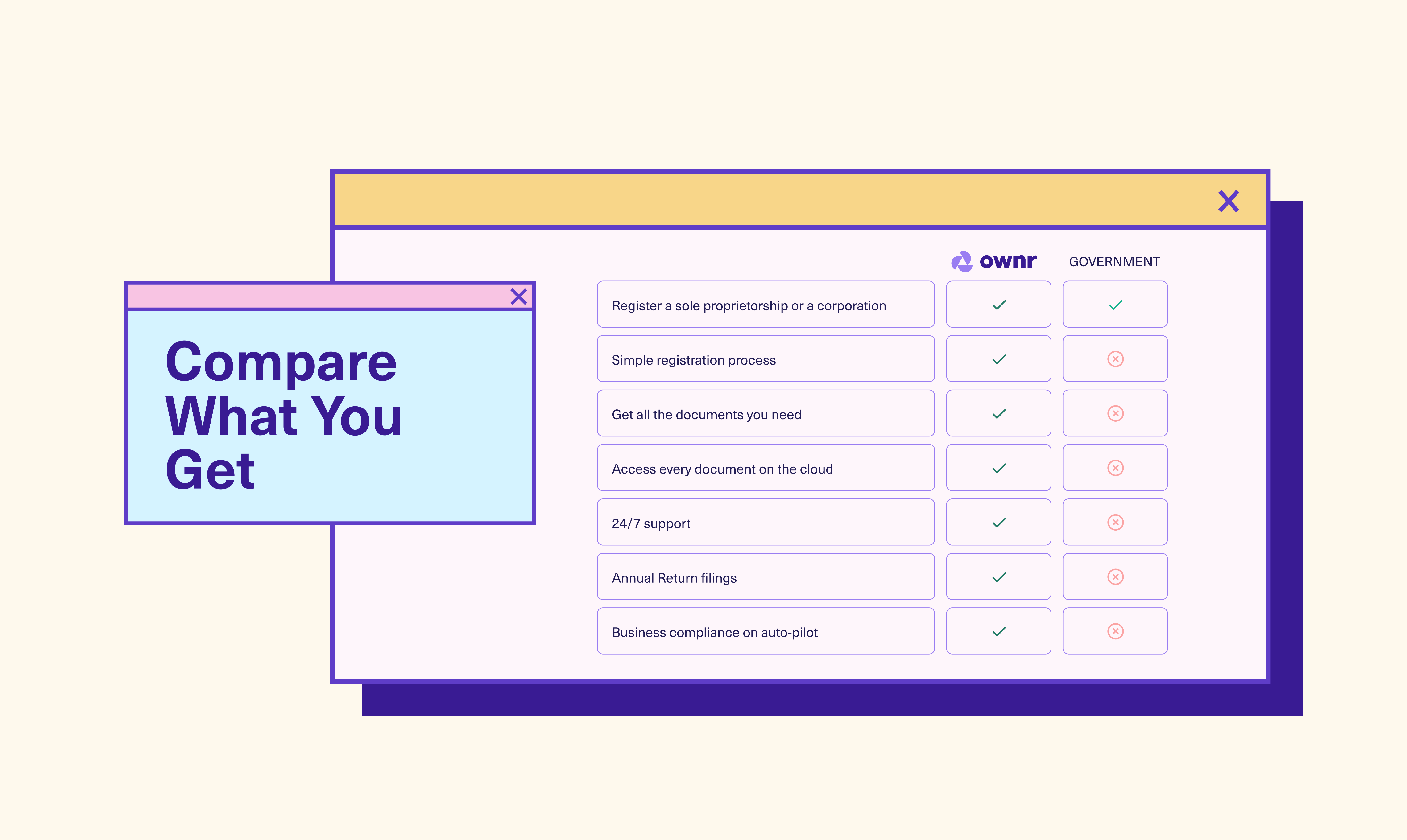
Deciding on the right business structure and registering your enterprise is an important step as you grow your small business. Ownr offers a much simpler process than if you were to file yourself with the government at just a fraction of the cost of hiring a lawyer. Using Ownr, you can register your sole proprietorship or incorporate your business in Ontario in just minutes. Sole proprietorship set-up with Ownr costs $49, and Ontario provincial incorporation packages start at $599 or opt for federal incorporation for $499.
The incorporation fee provides you with up to 30 free business name searches, and all mandatory documents (including the NUANS report, Articles of Incorporation, and a digital Minute Book for one year). In addition, if you open a new business account with RBC after incorporating with Ownr, you’ll get $300 back*.
Frequently asked questions
What documents do I need to complete business registration in Ontario?
To register a business in Ontario, you generally need your business name, the owner’s or partners’ legal names and contact details, the business’s principal address, and a brief description of what your business does.
If you are incorporating, you also need Articles of Incorporation, an Ontario-registered office address, director information, and, for a named corporation, an Ontario-biased NUANS name search report.
How long does it take to register a business in Ontario?
Most online sole proprietorship and partnership registrations through ServiceOntario are completed the same day. Incorporations may take longer, especially if extra documents, such as a NUANS report, are required or if you file federally rather than provincially.
Is my information secure when registering my business through Ownr?
Yes. Ownr uses secure, encrypted systems to protect your information, and handles data in line with Canadian privacy and security standards.
Does Ownr help with ongoing compliance after registration?
Yes. Ownr offers tools to support ongoing compliance, including annual returns, business information updates, and digital minute book management.



Launch your business starting at $49
This article offers general information only, is current as of the date of publication, and is not intended as legal, financial or other professional advice. A professional advisor should be consulted regarding your specific situation. While the information presented is believed to be factual and current, its accuracy is not guaranteed and it should not be regarded as a complete analysis of the subjects discussed. All expressions of opinion reflect the judgment of the author(s) as of the date of publication and are subject to change. No endorsement of any third parties or their advice, opinions, information, products or services is expressly given or implied by RBC Ventures Inc. or its affiliates.